
Zia Tile
ziatile.com · set in GT America
SaveUnofficial A style guide made by SiteStyleGuide from scientificamerican.com’s public web pages. Not affiliated with or endorsed by Scientific American. The real site is scientificamerican.com ↗

Unofficial style guide
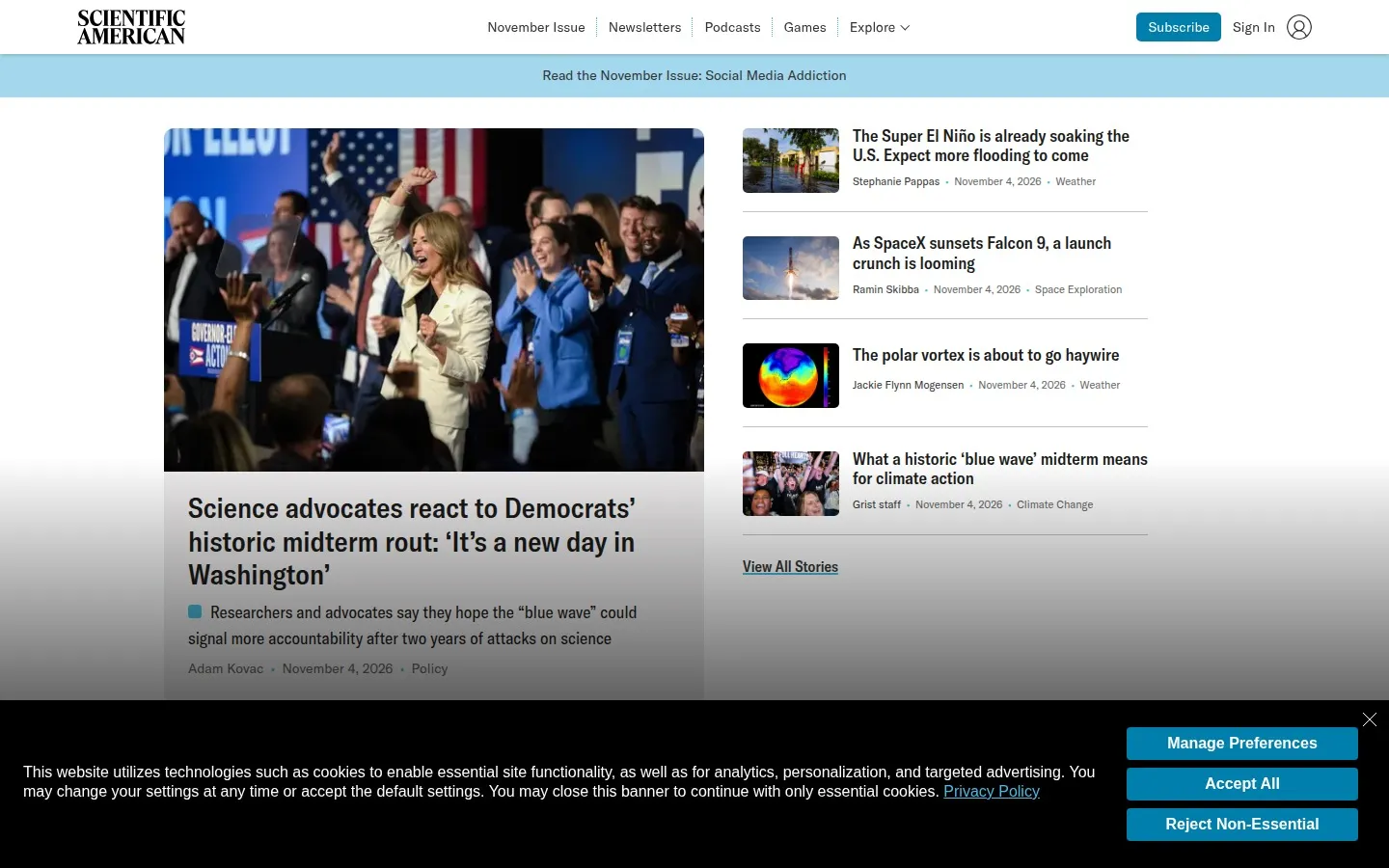
Scientific American’s website (scientificamerican.com) uses GT America for its headings and body text. Its palette is led by Deep Sky Blue (#4BBBE0), Steel Blue (#007FAD) and Deep Steel Blue (#0376A1), with #1A1A1A text on #FFFFFF. Captured from the live site on 5 November 2026.

Identity & metadata
What browsers, search engines and social cards show before anyone reaches the page, from the homepage’s <head>.
In search results
 Scientific Americanhttps://www.scientificamerican.com/
Scientific American
Scientific American is the essential guide to the most awe-inspiring advances in science and technology, explaining how they change our understanding of the worl…
When shared

scientificamerican.com
Scientific American
Scientific American is the essential guide to the most awe-inspiring advances in science and technology, expl…
Logo & favicons
Found as: schema.org logo. SVG, 150 × 150.
On white
On black
On Deep Sky Blue
32 px · ICO
icon shortcut
Scientific American
Light browser tab
Scientific American
Dark browser tab
Colour
Read from the site’s stylesheets and weighted by where each colour is used. Names are the nearest standard colour name. Click a swatch to copy its hex code.
Contrast is against the site’s text colour (#1A1A1A) and white, using WCAG 2 ratios: 4.5 for body text, 3 for large text.
By how often each colour appears in the site’s CSS, weighted by where (body, headings, buttons), not by area on the screen.
Text, background, border · html, --ring-offset-color
Text, background, border · .discussionCTA-lgi88 h2, .hp_native_ux2-7hMfx.is-loaded h2
Text, background, border · h2:where(.prose-mhScE>*), .newsletterBtn-P-9hW:disabled
Background, border · .ad-Xtmn1.is-loaded, figure:where(.prose-MpLPk>*):not(.does-not-exist-SALDg) img:before
Text, graphic, background · .dek-1DArZ>p:first-child:before, .message-BAUWT .icon-nKdsV
Text, background, graphic · --ring-color, .subscribeLink-9v3Mk
Background, border, text · .blue3Btn-bZbVn, .footerSubscribe-QtEdJ
Background, text, border · .salesBanner-10cNR, .footerSubscribe-012p2
Graphic, background · .collection-s5REU .button-KXV0y, .cardLink-6ovwL:before
Text, background · .userEnv-L6yV-.test-UiUzx, .dropdownIconContainer--yKdJ.test-UiUzx:after
Background, border · .blue2Btn--SiJW, .segmentItems-mJkDY
Background, text · .userEnv-L6yV-.stage-Lv-pV, .dropdownIconContainer--yKdJ.stage-Lv-pV:after
Text · .errorDetail-ZQ3bV, .errorInfo-Z25x1 .warn-TPi6t
Background · .discussionCTA-lgi88, --color-tan
Used · --font-stack-crimson
linear-gradient(135deg,transparent 25%,rgba(255,255,255,.1) 25%,rgba(255,255,255,.1) 50%,transparent 50%,transparent 75%,rgba(255,255,255,.1) 75%,rgba(255,255,255,.1))
linear-gradient(to top,#000,transparent)
Typography
Faces from Google Fonts are shown in the real thing. Others are licensed to the site, so they show in your device’s copy if you have one, or a stand-in if not.
GT America
Self-hosted · weights 100, 400, 700 · body, headings · shown in a stand-in if you don’t have it
GT America Condensed
Self-hosted · weights 400, 500, 700 · headings · shown in a stand-in if you don’t have it
Crimson Text
Self-hosted · weights 400, 600, 700 · headings · shown in a stand-in if you don’t have it
ABCDEFGHIJKLMNOPQRSTUVWXYZ
abcdefghijklmnopqrstuvwxyz
0123456789 ! ? & @ % $ – ’ “ ”
Scientific American
Scientific American
Scientific American
Scientific American is the essential guide to the most awe-inspiring advances in science and technology, explaining how they change our und…
Scientific American is the essential guide to the most awe-inspiring advances in science and technology, explaining how they change our und…
Read more about Scientific American
Elements
The main button and link as the site’s CSS draws them, and the corner radii and shadows it uses most.
Corner radius
Shadows
Layout
Breakpoints from the site’s media queries and the widths its content is held to, with how often each appears.
Breakpoints
On a scale of 0 to 1440 px.
Content widths (max-width)
Notes
Plain checks on what was found. Worth fixing if you look after this site.
Questions
Quick answers, from the same capture as the rest of this guide.
Design tokens
Everything above as CSS variables, ready to paste into a project. Members can download the tokens as files for Figma (Tokens Studio), Style Dictionary and Tailwind.
/* scientificamerican.com design tokens, from SiteStyleGuide (https://sitestyleguide.com/scientificamerican.com) */
:root {
  /* Colours */
  --text: #1A1A1A;
  --background: #FFFFFF;
  --colour-white: #FFFFFF;
  --colour-charcoal: #333333;
  --colour-dark-grey: #666666;
  --colour-off-white: #EBEBEB;
  --colour-deep-sky-blue: #4BBBE0;
  --colour-steel-blue: #007FAD;
  --colour-deep-steel-blue: #0376A1;
  --colour-light-blue: #A4D8EF;
  --colour-peru: #D58000;
  --colour-fire-brick: #A70E13;
  --colour-light-steel-blue: #008BBE;
  --colour-medium-sea-green: #00A859;
  --colour-dark-golden-rod: #A86800;
  --colour-bisque: #E8D3BE;
  --colour-crimson: #DC143C;
  --gradient-1: linear-gradient(135deg,transparent 25%,rgba(255,255,255,.1) 25%,rgba(255,255,255,.1) 50%,transparent 50%,transparent 75%,rgba(255,255,255,.1) 75%,rgba(255,255,255,.1));
  --gradient-2: linear-gradient(to top,#000,transparent);

  /* Typefaces */
  --font-body: 'GT America';
  --font-headings: 'GT America';

  /* Type scale */
  --text-h2: 1.125rem;
  --text-h3: .9rem;
  --leading-h3: normal;
  --text-h4: .8rem;
  --text-p: 1rem;
  --leading-p: 1.75;
  --text-a: 1.125rem;

  /* Shape */
  --radius-1: 5px;
  --radius-2: 3px;
  --radius-3: 2px;
  --radius-4: 100%;
  --radius-5: 10px;

  /* Layout (breakpoints can’t be used in media queries as variables; they’re here for reference) */
  --breakpoint-1: 700px;
  --breakpoint-2: 750px;
  --breakpoint-3: 800px;
  --breakpoint-4: 840px;
  --breakpoint-5: 899px;
  --breakpoint-6: 900px;
  --breakpoint-7: 950px;
  --breakpoint-8: 1280px;
  --max-width-1: 800px;
  --max-width-2: 565px;
  --max-width-3: 470px;
  --max-width-4: 420px;
  --max-width-5: 400px;
  --max-width-6: 360px;
}
{
    "site": "scientificamerican.com",
    "source": "https://sitestyleguide.com/scientificamerican.com",
    "text": "#1A1A1A",
    "background": "#FFFFFF",
    "colours": [
        {
            "name": "White",
            "hex": "#FFFFFF",
            "rgb": [
                255,
                255,
                255
            ]
        },
        {
            "name": "Charcoal",
            "hex": "#333333",
            "rgb": [
                51,
                51,
                51
            ]
        },
        {
            "name": "Dark Grey",
            "hex": "#666666",
            "rgb": [
                102,
                102,
                102
            ]
        },
        {
            "name": "Off White",
            "hex": "#EBEBEB",
            "rgb": [
                235,
                235,
                235
            ]
        },
        {
            "name": "Deep Sky Blue",
            "hex": "#4BBBE0",
            "rgb": [
                75,
                187,
                224
            ]
        },
        {
            "name": "Steel Blue",
            "hex": "#007FAD",
            "rgb": [
                0,
                127,
                173
            ]
        },
        {
            "name": "Deep Steel Blue",
            "hex": "#0376A1",
            "rgb": [
                3,
                118,
                161
            ]
        },
        {
            "name": "Light Blue",
            "hex": "#A4D8EF",
            "rgb": [
                164,
                216,
                239
            ]
        },
        {
            "name": "Peru",
            "hex": "#D58000",
            "rgb": [
                213,
                128,
                0
            ]
        },
        {
            "name": "Fire Brick",
            "hex": "#A70E13",
            "rgb": [
                167,
                14,
                19
            ]
        },
        {
            "name": "Light Steel Blue",
            "hex": "#008BBE",
            "rgb": [
                0,
                139,
                190
            ]
        },
        {
            "name": "Medium Sea Green",
            "hex": "#00A859",
            "rgb": [
                0,
                168,
                89
            ]
        },
        {
            "name": "Dark Golden Rod",
            "hex": "#A86800",
            "rgb": [
                168,
                104,
                0
            ]
        },
        {
            "name": "Bisque",
            "hex": "#E8D3BE",
            "rgb": [
                232,
                211,
                190
            ]
        },
        {
            "name": "Crimson",
            "hex": "#DC143C",
            "rgb": [
                220,
                20,
                60
            ]
        }
    ],
    "fonts": [
        {
            "name": "GT America",
            "stack": "\"GT America\", \"America Temp: Helvetica Neue\", \"America Temp: Helvetica\", \"America Temp: Arial\", \"America Temp: Roboto\"",
            "weights": [
                100,
                400,
                700
            ],
            "source": "Self-hosted"
        },
        {
            "name": "GT America Condensed",
            "stack": "\"GT America Condensed\", \"America Condensed Temp: Roboto Condensed\", \"America Condensed Temp: Avenir Next Condensed\", \"America Condensed Temp: Arial Narrow\", \"America Condensed Temp: Arial\"",
            "weights": [
                400,
                500,
                700
            ],
            "source": "Self-hosted"
        },
        {
            "name": "Crimson Text",
            "stack": "\"Crimson Text\", \"Crimson Temp: Georgia\"",
            "weights": [
                400,
                600,
                700
            ],
            "source": "Self-hosted"
        }
    ]
}
Share
Links open each service’s own share page. Nothing from them loads here.
Link to this guide from your own site, so your team, designers and agencies can find your colours and fonts in one place.

<a href="https://sitestyleguide.com/scientificamerican.com" title="Scientific American style guide on SiteStyleGuide"><img src="https://sitestyleguide.com/public/badge.svg" alt="View our style guide on SiteStyleGuide" width="200" height="44"></a>
ziatile.com · set in GT America
Save
frog.co · set in GT America
Save
betterment.com · set in GT America
Save
emergencemagazine.org · set in GT America
SaveCaptured from scientificamerican.com on 5 November 2026. SiteStyleGuide isn’t affiliated with or endorsed by Scientific American; this guide describes the public website for reference.
Analytics cookies
We’d like to use Google Analytics cookies to count visits and see which pages are useful. Nothing is used for advertising.


